Tuesday, November 10, 2009

Tuesday November 10, 2009
Management of Renal Failure in End Stage Liver Disease

(Total time 44:21)

Monday, November 9, 2009

Monday November 9, 2009

Q: What is the mechanism of action of B-blockers in reducing portal hypertension which ultimately help in reducing variceal bleeding?

Answer: Nonselective beta-blockers like propranolol and nadolol, reduce portal pressure through both local and systemic effects by 9% to 31%.

Local: In the splanchnic circulation, blockade of the vasodilating beta2 adrenoreceptors results in unrestricted alpha-adrenergic activity, splanchnic arteriolar vasoconstriction, and decreased portal inflow.

Systemic: Blockade of the cardiac beta1 receptors decreases the heart rate and cardiac output and secondarily decreases portal inflow.

Sunday, November 8, 2009

Sunday November 8, 2009


Q: Which medicine may transiently reverse hepatic encephelopathy?

Answer:
flumazenil

GABA is a neuroinhibitory substance produced in the gastrointestinal tract. Of all brain nerve endings, 24-45% may be GABAergic. Increased GABAergic tone is observed in patients with cirrhosis, perhaps because of decreased hepatic metabolism of GABA.

When GABA crosses the extrapermeable blood-brain barrier of patients with cirrhosis, it interacts with supersensitive postsynaptic GABA receptors. The GABA receptor, in conjunction with receptors for benzodiazepines and barbiturates, regulates a chloride ionophore. Binding of GABA to its receptor permits an influx of chloride ions into the postsynaptic neuron, leading to the generation of an inhibitory postsynaptic potential. Administration of benzodiazepines and barbiturates to patients with cirrhosis increases GABAergic tone and predisposes to depressed consciousness.

The GABA hypothesis is supported by the clinical observation that flumazenil, a benzodiazepine antagonist, can transiently reverse hepatic encephalopathy in patients with cirrhosis.
Saturday, November 7, 2009

Saturday November 7, 2009
Naloxone for shock

Background: There is pre-clinical evidence, involving several animal species, suggesting that opioid peptides play a role in the physiopathology of shock (endotoxic, hypovolemic, cardiogenic, spinal, anaphylactic). Many case reports have suggested that naloxone (an opiate antagonist) might be an effective treatment for shock in humans, but others have not supported such a point of view. This controversy led us to undertake a meta-analysis of the available evidence on the efficacy of naloxone as a treatment measure for shock in humans.

Objectives: To evaluate the effectiveness and safety of naloxone in human shock and to estimate the methodological quality of the clinical trials.

Search strategy: We searched the Cochrane Injuries Group Specialised Register, CENTRAL (The Cochrane Library), MEDLINE (Ovid SP), PubMed, EMBASE (Ovid SP), ISI Web of Science: Science Citation Index Expanded (SCI-EXPANDED), and ISI Web of Science: Conference Proceedings Citation Index-Science (CPCI-S) (to December 2008). In order to identify further studies the reference lists of all included papers were examined and the primary investigators of eligible studies were contacted.

Selection criteria: Randomized controlled trials evaluating naloxone in human shock, regardless of the patient's age (adult, child, or neonate).

Data collection and analysis: Three independent review authors extracted data on study design, intervention, outcomes, and methodological quality.

Three independent readers reviewed 120 publications and selected six clinical trials. Overall agreement on study selection was perfect (concordance: 100%). The meta-analysis includes six studies involving 126 patients with septic, cardiogenic, hemorrhagic, or spinal shock.

Main results:
  • Naloxone therapy was associated with statistically significant hemodynamic improvement (odds ratio 0.24; 95% confidence interval (CI) 0.09 to 0.68).
  • The mean arterial pressure was significantly higher in the naloxone groups than in the placebo groups (weighted mean difference +9.33 mm Hg; 95% CI 7.07 to 11.59). No heterogeneity was found for this outcome.
  • The death rate was lower in the naloxone group (odds ratio 0.59; 95% CI 0.21 was 1.67) but this was consistent with the play of chance. A significant heterogeneity was detected for the latter outcome (P less than 0.05).

Authors' conclusions: Naloxone improves blood pressure, especially mean arterial blood pressure. However, the clinical usefulness of naloxone to treat shock remains to be determined and additional randomized controlled trials are needed to assess its usefulness.


This is a Cochrane review abstract and plain language summary, prepared and maintained by The Cochrane Collaboration, currently published in The Cochrane Database of Systematic Reviews 2009 Issue 4, Copyright © 2009 The Cochrane Collaboration. Published by John Wiley and Sons, Ltd.. The full text of the review is available in The Cochrane Library.

This record should be cited as: Boeuf B, Poirier V, Gauvin F, Guerguerian AM, Roy C, Farrell C, Lacroix J. Naloxone for shock. Cochrane Database of Systematic Reviews 2003, Issue 3

http://www.cochrane.org/reviews/en/ab004443.html

Friday, November 6, 2009

Friday November 6, 2009
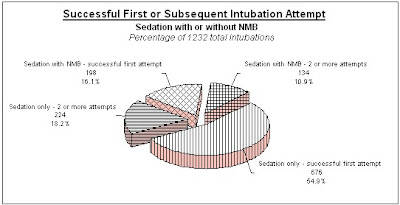
On Use of NMB for the emergent tracheal intubation

Use of NMB is not routinely needed for the emergent tracheal intubation of inpatients who have received adjunct sedation. Emergent inpatient tracheal intubations, in which NMB had been utilized, were associated with a greater number of intubation attempts. The use of NMB, in only a subset of inpatients, may have been due to such issues as agitation, movement, or jaw clenching. These may have happened even with seemingly adequate levels of sedation. The observed association of NMB, with a greater number of tracheal intubation attempts, may actually have represented the failure to have successfully intubated with the use of sedation alone.

Clinicians need to be aware that the routine use of NMB may not be indicated for emergent tracheal intubations of inpatients who have received sedation. Although uncommon, the use of NMB may lead to catastrophic situations in which the patient can neither be intubated nor ventilated by mask. Additionally, breath sounds, transmitted via the tracheal tube during intubation, are lost with the use of NMB. Therefore, the advantages of intubating a spontaneously breathing patient are readily evident.

There is tremendous potential for hypoxia-related complications from the use of NMB. Consideration should be given to initially attempt those emergent inpatient tracheal intubations, which require sedation, without NMB. This is especially true in situations where additional trained personnel and airway management equipment are not readily available.


Intubation of Inpatients: A Retrospective Practice Analysis Comparing Adjunct Sedation With or Without Neuromuscular Blockade . The Internet Journal of Anesthesiology. 2003 Volume 7 Number 2

Thursday, November 5, 2009

Thursday November 5, 2009


Q: Define Massive Hemoptysis?

Answer:
Traditionally 600 mL in 24 hours is a common definition of "massive hemoptysis" although a range of 200 to 1000 mL has been described. Since the actual volume is almost never measured, most physicians become concerned when an estimated 200 to 400 mL is expectorated and use this value as a definition of massive hemoptysis.

One reason to classify hemoptysis is to establish prognosis. Reported mortality in massive hemoptysis has ranged from less than 10% with intervention to 85% without intervention. Perhaps more important than expectorated volume is the rate of bleeding. Fortunately, massive hemoptysis is infrequent, with an incidence of less than 10%.

Wednesday, November 4, 2009

Wednesday November 4, 2009
Low molecular weight protamine?

See following abstract

Heparin employed in cardiovascular surgeries often leads to a high incidence of bleeding complications. Protamine employed in heparin reversal, however, can cause severe adverse reactions. In an attempt to address this clinical problem, we developed low molecular weight protamine (LMWP) as a potentially effective and less toxic heparin antagonist.

A homogeneous 1880-d peptide fragment, termed LMWP-TDSP5 and containing the amino acid sequence of VSRRRRRRGGRRRR was derived directly from protamine by enzymatic digestion of protamine with thermolysin.

In vitro studies demonstrated that TDSP5 was capable of neutralizing various anticoagulant functions of both heparin and commercial low molecular weight heparin preparations. In addition, TDSP5 exhibited significantly reduced crossreactivity toward mouse sera containing antiprotamine antibodies. TDSP5 showed a decrease in its potential in activating the complement system. All of these findings suggested the possibility of markedly reduced protamine toxicity for TDSP5.

In this article, we conducted preliminary in vivo studies to further demonstrate the feasibility and utility of using LMWP as a nontoxic clinical protamine substitute. Dogs were chosen as test animals because they were known to magnify the typical human response to protamine. By using a full spectra of biological and clinical assays for heparin, including the anti-IIa and anti-Xa chromogenic assays and the activated partial, thromboplastin time and TCT clotting assays, TDSP5 showed that it could completely neutralize all these different anticoagulant functions of heparin in dogs. Although administration of protamine in dogs produced a significant reduction in mean arterial blood pressure (−14.9 mm Hg) and elevation in pulmonary artery systolic pressure (+5.0 mm Hg), the use of TDSP5 in dogs did not elicit any statistically significant change in any of the variables measured. Furthermore, the use of LMWP also significantly reduced the protamine-induced transient thrombocytopenic and granulocytopenic responses. The white blood cell counts and platelet counts decreased to 82.1% and 60.0% of baseline, respectively, in dogs given intravenous protamine compared to 97.8% and 88.6% of baseline in dogs receiving TDSP5. These preliminary findings indicated that LMWP could potentially provide an effective and safe means to control both heparin - and protamine-induced complications.


Reference: Click to get abstract

Low molecular weight protamine as nontoxic heparin/low molecular weight heparin antidote (III): Preliminary in vivo evaluation of efficacy and toxicity using a canine model - The AAPS Journal, Volume 3, Number 3 / September, 2001